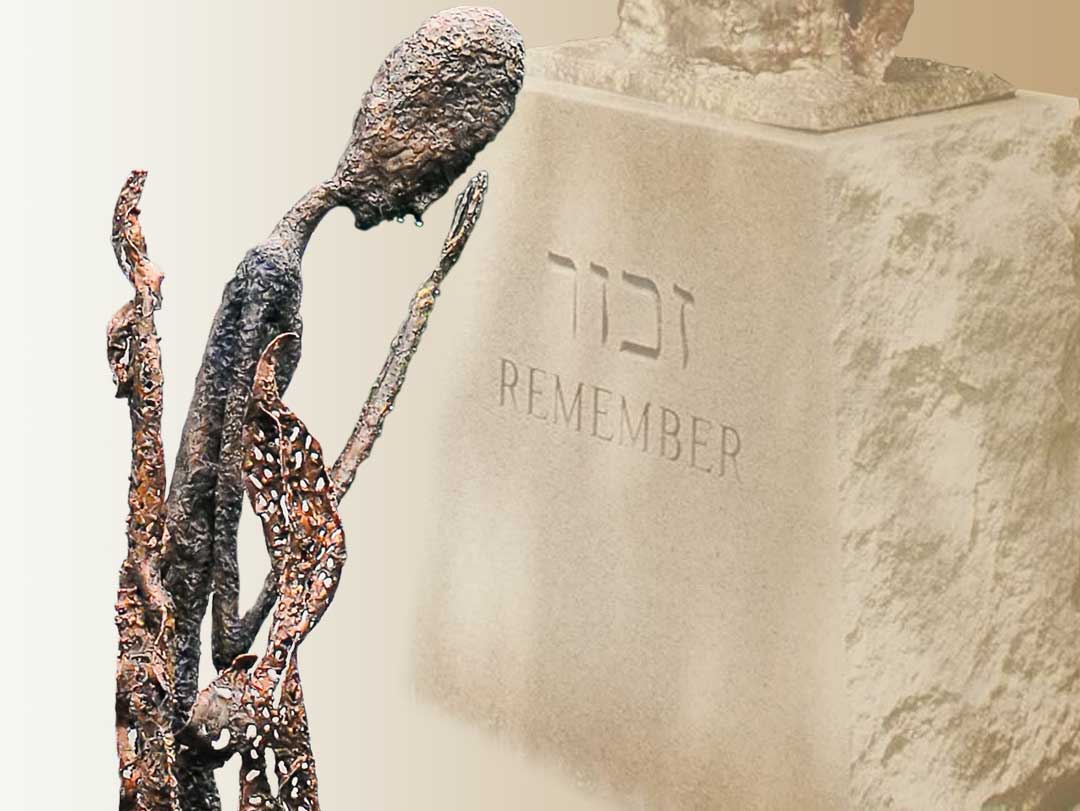
Image of Rachel Weeping statue and base at the Holocaust Memorial in Richmond, VA
Years ago when I served in Richmond, I had a view of a Holocaust Memorial on the grounds of the Cathedral outside my office window. It depicted Rachael weeping for her children amidst flames. On the base there was a single word carved in Hebrew and English, “Remember.” It is indeed important for humanity to “remember” this singularly heinous event in human history. It is important for us to “remember” people wherever and whenever they suffer.
I recently returned from a visit to Israel and the occupied West Bank and Gaza. Israel and the Palestinian Territories are tense places these days. Israelis fear random knife attacks; Palestinians fear the harsh realities of occupation and the lack of freedom of movement. Continue reading →
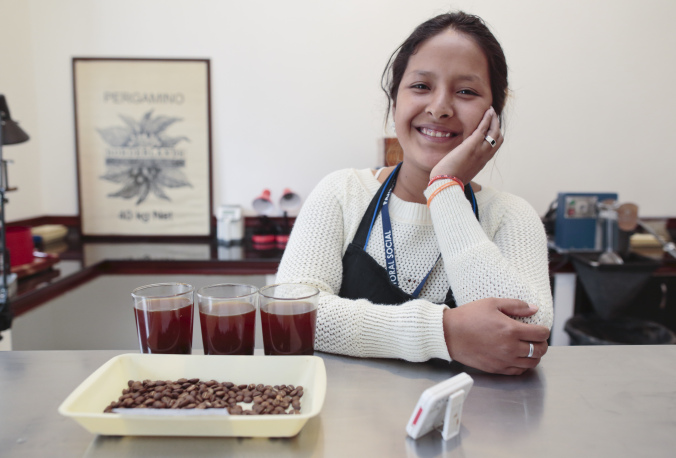
Portrait of Maria Yelud Leyton Chavez, 18, in charge of the Borderlands project coffee quality lab at Pasto, Nario in Colombia. Photo by Oscar Leiva/Silverlight for Catholic Relief Services
Fighting between armed forces made life in Cumbitara, Colombia, dangerous for Maria and her family-so dangerous that 8 years ago they were forced to relocate. They left their home one morning with nothing but a suitcase of clothes.
It wasn’t easy making a new life in Nariño, a region of Colombia known for its coffee. People made fun of Maria and her family because they were outsiders. It was also hard to find work, and Maria’s father left home for months at a time to do dangerous work in a mine. Continue reading →
The Sixth Station of the Cross speaks in a special way to how we live out mercy during Lent. In this Station we see Veronica not just wiping the face of Christ, but reaching out—at some danger to herself—to touch Jesus, to be present to a man who was suffering. Why would she do this? What difference was she really making? After all, Jesus was on his way to die—a simple cloth wasn’t going to change that.
So often, we are tempted to feel this way as we look out at our world so full of tragedy. We think, our little gesture won’t amount to anything—a few dollars here, some time spent there. What difference will that make? At those moments, we should remind ourselves of Veronica. Veronica was quite literally present to the suffering Christ. She reached out to him, and he reached back. That’s what we’re called to do. We should never underestimate the value of simply being present, of reaching out in mercy and love to another human being, someone made in the image and likeness of God. And we must allow those whom we serve to reach back, to touch our hearts and our lives. As we are the hands of Christ, so, too, are those whom we serve.
This is what the Holy Father has called us to reflect on during this Year of Mercy. This is what we do each Lent. We call it the CRS Rice Bowl Effect.
How can a cardboard box help you touch the face of Christ during Lent?
Meet Mayra. She’s a young student from Honduras whose life has been changed thanks to the prayers, fasting and almsgiving of Catholics in the United States. She’s also one of the people featured in CRS Rice Bowl this year. This video has more.
You saw how CRS Rice Bowl has given her the tools and confidence she needs to succeed in school—even in a country beset by poverty, violence and hardship. Mayra has received her diploma and is now looking to tutor her peers. And she’s made a new friend in Fabricio.
In Mayra, we see Christ—and we reach out across culture and countries to be present. That’s the CRS Rice Bowl Effect.
How does Christ reach back? What effect does Mayra have on us?
Let’s take a moment to reflect on the image below.
Photo Credit: Catholic Relief Services
When I first saw this image, it made me pause. It’s a beautiful photograph, artistically done, with good lighting and excellent composition. But more importantly, what really touches the viewer is that it quite clearly shows love, the love shared between grandmother and granddaughter. I saw this photograph before I had heard Mayra’s story, before I’d met her or her grandmother. But what is evident in this image comes through clearly in her story: we see the love of a grandmother for her granddaughter. We see a grandmother who will sacrifice to help improve the life of someone she loves. Perhaps, we even glimpse the merciful love of God, a God who loves and sacrifices no matter the cost.
That, too, is the CRS Rice Bowl Effect—and it’s powerful. It’s inspiring to me to see the hard work of this elderly woman. She challenges me in my own life—to love, to sacrifice. And, she challenges me in my own relationship with God.
This Lent, I hope you will share the CRS Rice Bowl Effect with your families and the communities you serve. Encourage them not just to reach out to those in need through their Lenten almsgiving, but, through prayerful reflection, to allow the stories of these women and men to touch their own lives.
Then we, too, can truly be like Veronica, encountering the suffering Christ. And we, too, can live Pope Francis’ call to mercy.
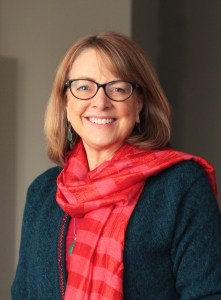
Joan Rosenhauer is Executive Vice President, US Operations at Catholic Relief Services
The mass shooting on December 2nd has devastated our communities here in the Diocese of San Bernardino. We continue to pray for the repose of the souls of the 14 victims that lost their lives in this terrible shooting.
The husband of the principal of our Catholic Parish School at Sacred Heart in Rancho Cucamonga was one of the victims. His name was Mr. Damian Meins. His funeral was on Friday, December 11th. Our prayers go out to the family of Mr. Meins and all of the families who have lost their loved ones. Mr. Damian Meins worked for the County of Riverside for 28 years and had recently begun working for the San Bernardino County of Environmental Health Department. He was also the physical education teacher at St. Catherine of Alexandria School in Riverside and for the past few years had dressed up as Santa for the school. He is remembered as being kind-hearted, compassionate, and caring.
Before the shooting happened, we at the Social Concerns Office of the Diocese of San Bernardino had organized a Taize Prayer in collaboration with the Global Solidarity Diocesan Committee, Catholic Relief Services (CRS), and Sacred Heart Parish in Rancho Cucamonga. The Taize prayer vigil was to show solidarity for refugees and the victims of the Paris attack. We had distributed the flyer months ahead of time. It is a deep mystery to see that the same parish that helped organize a prayer to show solidarity for victims of terrorist violence was now directly affected by senseless violence in their own city.
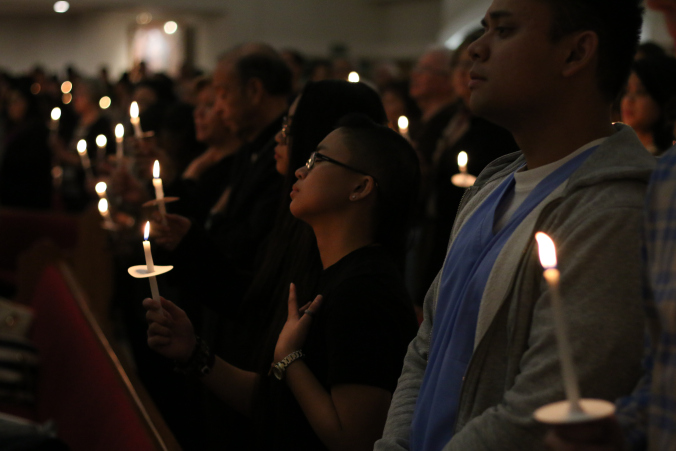
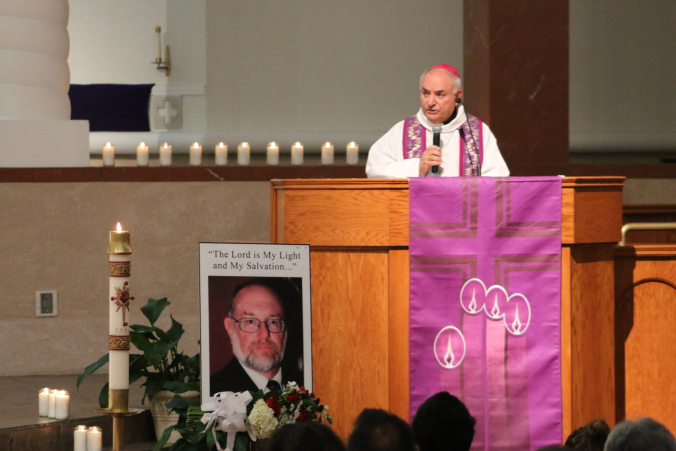
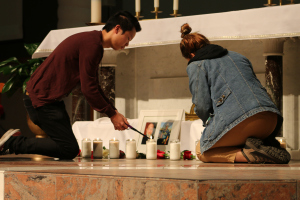
On December 4th, two days after the mass shooting, the organizing committee gathered to revise the Taize Prayer to integrate a special prayer to show solidarity for the 14 victims of the San Bernardino tragedy and specifically for Mr. Meins and his family. The diocese, parish, and school community gathered to pray and light candles for healing and peace. Most Reverend Bishop Barnes, Bishop of San Bernardino and Rev. Benedict C. Nwaschukwu, Parish Pastor guided us in our prayer.
The presence of Bishop Barnes was especially meaningful to the healing process of the Sacred Heart Parish community. Bishop, our pastor, was with us.
In times of deep suffering it is healing to experience clear signs of Emmanuel: God with us. “Even though I walk in the dark valley, I fear no evil; for you are at my side with your rod and your staff that give me courage.” ( Psalm 23:4) Bishop Barnes was with his people and expressed his empathy and solidarity. He said: “For some of us, it will take much longer to heal. And we respect where each person is in their pain, in their anger, in their sorrow, in their confusion.”
He added: “Let your hearts and your minds be open to God’s message for you, for all of us, for our communities and our families. Be open to where our God, a God of mercy and love, leads us.”
At the end of the prayer, the students of Sacred Heart Parish School offered fresh roses in memory of Mr. Meins.
On December 7th, two days after the Taize Prayer at Sacred Heart Parish, an interreligious prayer vigil at San Bernardino’s Our Lady of the Rosary Cathedral was organized in order to comfort friends and families of the victims, first responders and other civic leaders affected by the Dec. 2 attack. Inland Congregations United for Change, a group Catholic Campaign for Human Development has supported, was key in organizing the interfaith prayer vigil. Bishop Barnes gave the opening address and expressed: “We want what is good for our community. We do not want evil to win over our hearts, our pain to paralyze our future. We do not want our hearts to turn against any person, any race, any religion.”
As a community, we are discerning ways to continue our healing process. We understand it may be a slow and long process. People are afraid and have many mixed emotions. However, we as a faith community would like to be a source of hope because as Bishop Barnes expressed at the interreligious prayer vigil: “We believe that love is greater than hate; courage greater than fear; unity greater than separation.”
We, at the Diocese of San Bernardino, are thankful to all the people who have expressed their support in these challenging times. Thank you for letting us know that we are not alone; that you are with us in your prayers and acts of solidarity.
Sr. Hortensia Del Villar, SAC is the Director of Social Concerns in the Diocese of San Bernardino.
Photos by Andres Rivera, courtesy of the Diocese of San Bernardino
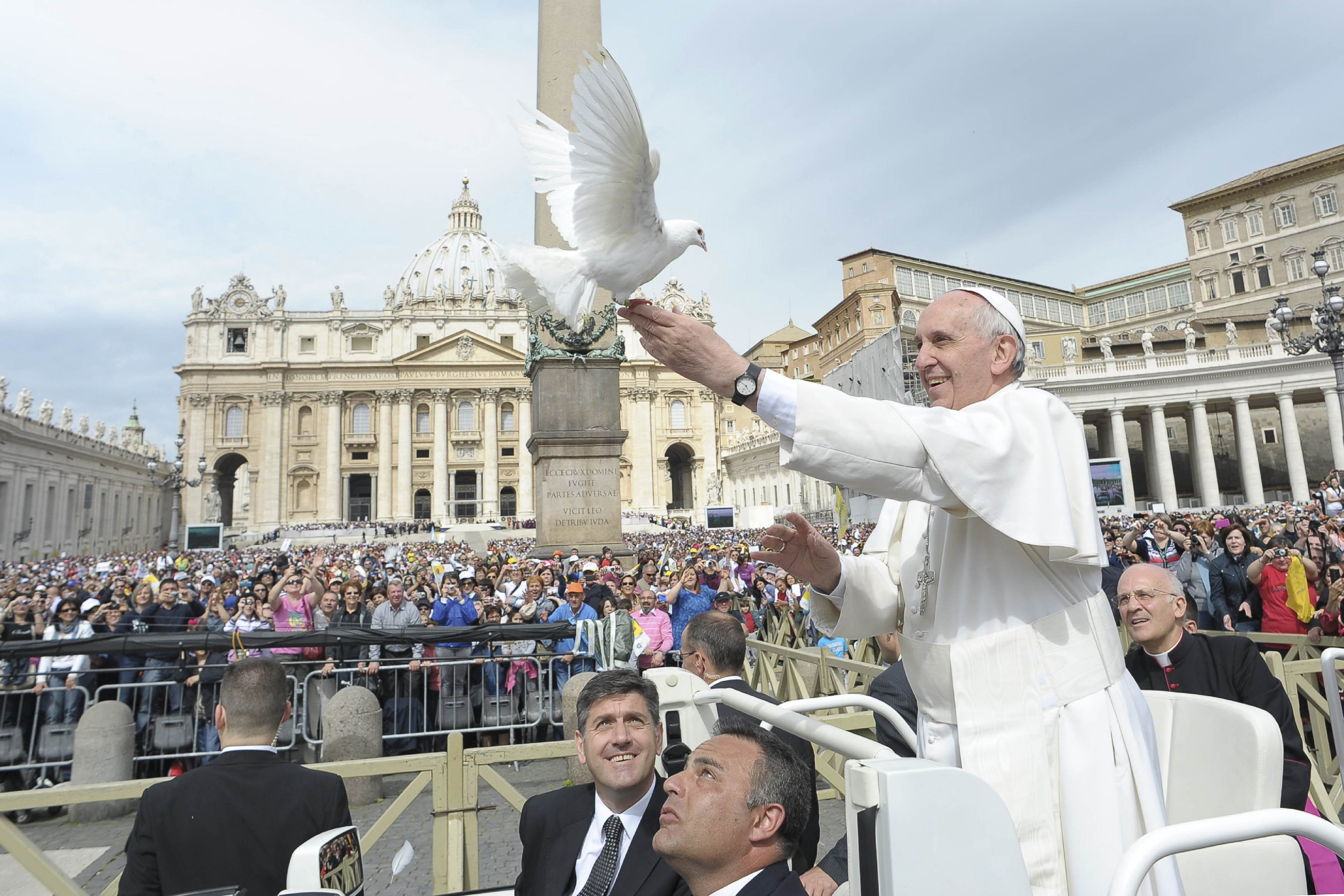
Pope Francis holds a dove before his weekly audience in St. Peter’s Square at the Vatican May 15. (CNS photo/L’Osservatore Romano via Reuters)
Later this week, Pope Francis will make his first pastoral visit to Africa. He will visit Kenya, Uganda, and if the security situation allows, the Central African Republic. Throughout his pontificate, the Holy Father has championed the cause of those living in poverty. On the world scene, Sub Saharan Africa is where the marginalized of the world are concentrated. According to the World Bank, in 1990 50% of the world’s poor lived in Southeast Asia while Africa accounted for only around 15%. The Bank projects that in 2015 those continents will change places with Africa holding about half of the world’s poor. Yet, Africa represents only around 15% of the world’s population.
Pope Francis very likely will make this disparity a key message to the world. He will probably call on the world’s developed countries to increase their investment in poverty eradication where the poor are concentrated – in Africa.
November 25-27, Pope Francis will be in Kenya. There, Pope Francis may address the long-term ethnic conflict that has been instigated and used by political leaders for decades. Conflict over land, especially in the fertile areas of the country, is closely linked to ethnic tensions. Ethnic groups tend to be concentrated in particular areas of the country, and some groups feel their land has been taken by the more powerful and politically connected ethnic groups. Church leaders have spoken out against ethnic-based politics and the resulting violent conflicts. The Holy Father may urge the Church and the government to defuse tensions through more systematic and sustained dialogue and reconciliation programs.
For decades, Muslims and Christians have lived side-by-side in relative peace in Kenya. When Somalia descended into conflict, refugees streamed into Kenya, but Muslim-Christian relations remained positive. When the Kenyan army intervened in Somalia, however, that changed. The Westgate Mall attack and more recent terrorist acts have created significant anti-Muslim sentiments, resulting in heavy-handed actions by government police and military against Muslims. This in turn has fostered grievances among peaceful people in the Muslim community. The Holy Father will perhaps stress the need for greater Muslim-Christian dialogue.
Governance issues and corruption have been long standing problems in Kenya. They are some of the root causes of the worsening ethnic conflict. The Holy Father may call for greater inclusive, transparent, and responsive government in a pastoral way.
While South Sudan is not on the Pope’s visit schedule, the Holy See has followed the tragic civil war there closely. Cardinal Peter Turkson, President of the Pontifical Council on International Justice and Peace, visited South Sudan last year. Pope Francis may make a statement on the situation in South Sudan and encourage the Catholic Church and the South Sudan Council of Churches to persist in their efforts to promote reconciliation, dialogue between political leaders, and regional cooperation to help South Sudan achieve peace.
From November 27-29, Pope Francis will be in Uganda, a country that has been relatively peaceful. Tensions are rising due to worsening corruption and neglectful governance and increasing civil rights violations by President Museveni’s government, in power for almost 30 years. The Holy Father may address governance issues by evoking his themes of caring for the poor and the marginalized.
On November 29-30, Pope Francis is expected to visit the Central African Republic, which is struggling to recover from decades of bad governance and two years of violent conflict. The country is trying to organize elections and inaugurate the first legitimate government in its history. Violence between militia groups continues, and the fate of a peaceful transition hangs in the balance. The Church leads the Religious Leaders’ Platform that is calling for donor nations to give the transitional government the time and resources it needs to organize a credible election. The Pope’s visit could be the catalyst for real positive change if he can encourage the belligerents to reject their violent ways, empower religious leaders, and urge donors to fund peacebuilding efforts.
Throughout his journey, we expect to see Pope Francis bringing the hallmarks of his Papacy: preaching joy of the Gospel, being close to the poor and marginalized, and spreading message of mercy and reconciliation.
In advance of the Pope’s visit to Kenya, the Kenya Conference of Catholic Bishops has released a special prayer for the visit. We invite you to follow Pope Francis’ visit in the news and ask that you pray for him and for peace in South Sudan and the Central African Republic.
See the full schedule for Pope Francis’ Visit to Africa, November 25-30.
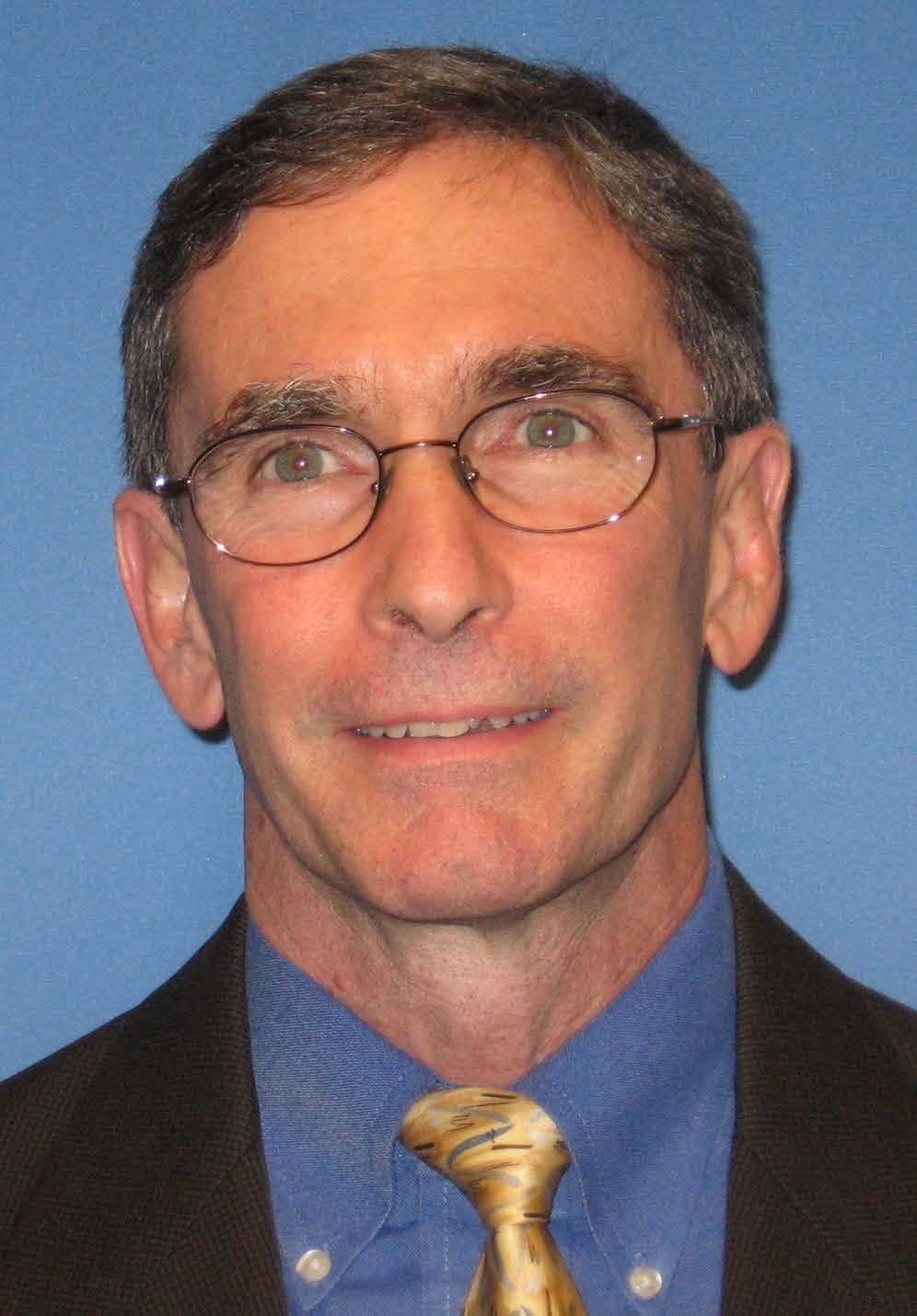
Steve Hilbert is a policy advisor on Africa for the Office of International Justice and Peace at the United States Conference of Catholic Bishops.
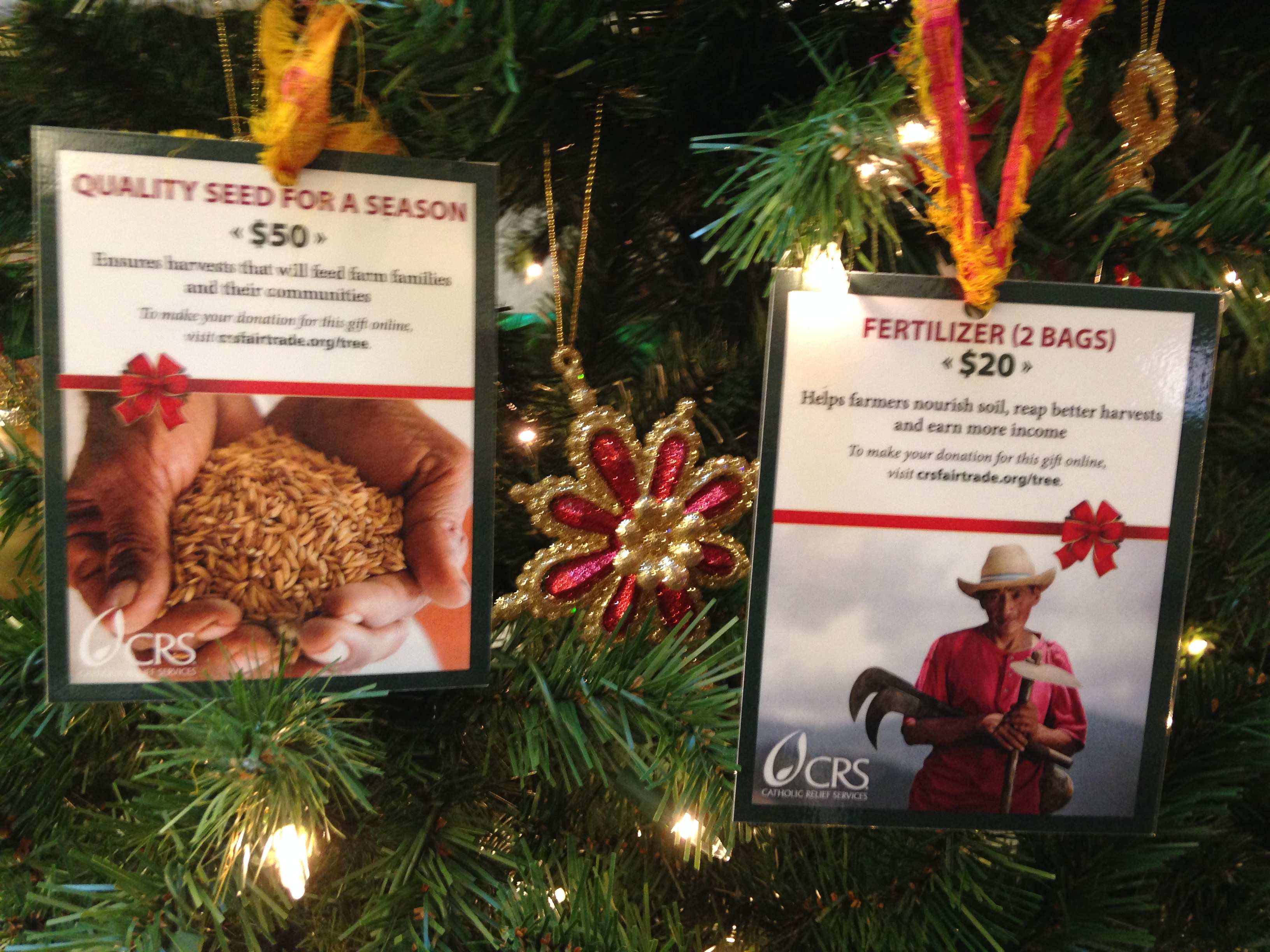
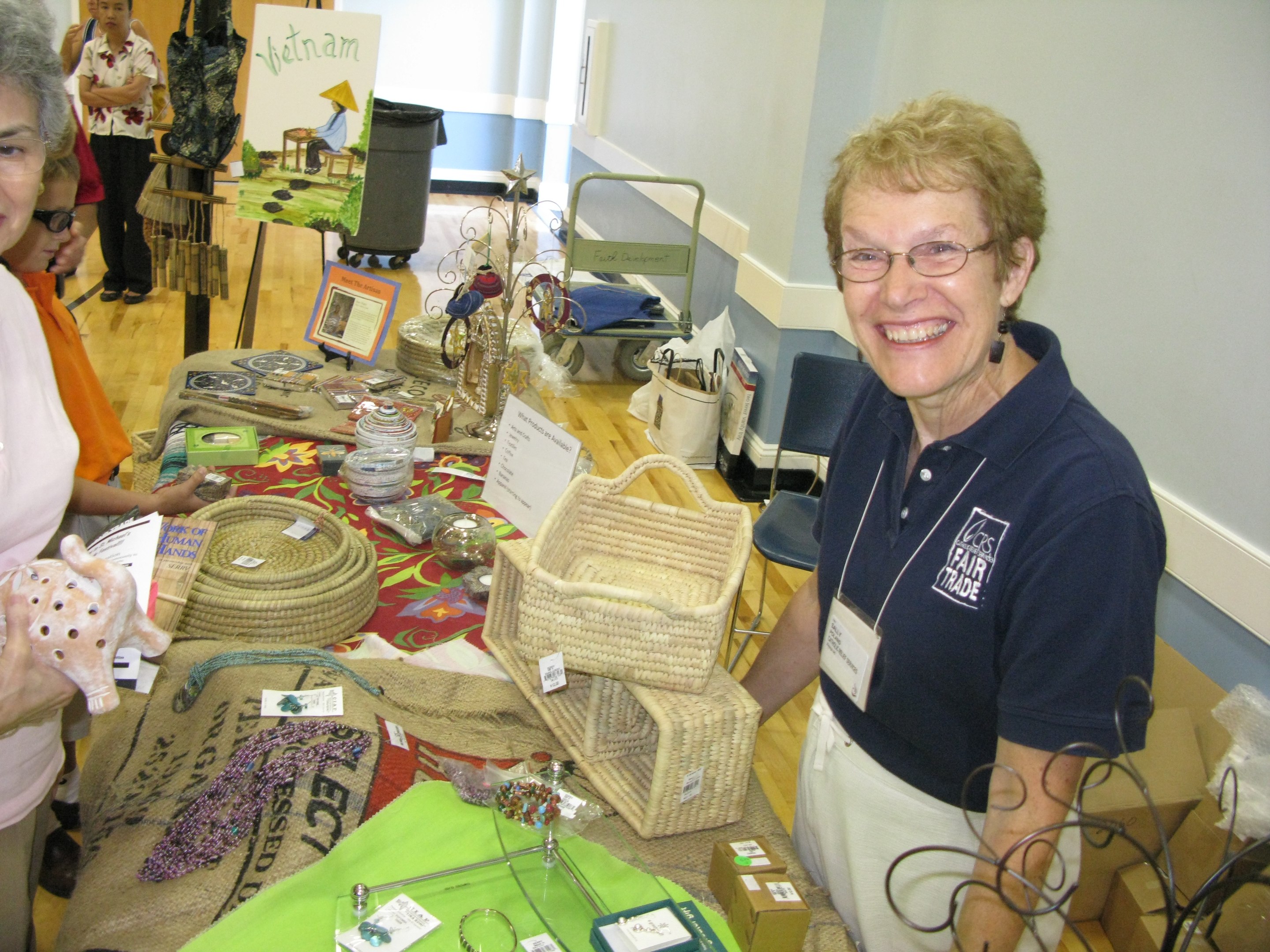
In October Catholic Relief Services (CRS) Fair Trade celebrates the fair trade movement in a special way. At its core, the fair trade movement creates enduring relationships that uplift human dignity and ensure a better work environment for marginalized farmers and artisans around the globe.
Over the years, I’ve had the privilege to meet artisans and farmers whose lives are positively impacted by the benefits of a trading system that pays a fair price, provides monetary support for community development projects, and supports farmers and artisans with financing and product development.
Fatima Ali, President of Kuapa KoKoo Farmers Union
Farmers like Fatima Ali, president of the Kuapa KoKo farmers union in Ghana. Her farmers union produces the cocoa for Divine chocolate. Fatima shared with me the real impact that fair trade has had on her life and the life of her community: financial independence, schooling for children, a well with clean water, and safe secure houses.
When economic justice is your job, it is sometimes easy to get lost in the details and complexity but it really is quite simple. Every day our economic choices affect our brothers and sisters around the world positively or negatively.
Here are five simple ways to live your faith in the market place and encourage your school, parish, or community to do the same.
Bring faith formation to life through reflections, prayers, and activities with a global perspective. Find out how fair trade relates to our faith with our Catholic Social Teaching and fair trade resources. You can also prepare for Advent with special prayers, weekly reflections connected to the Gospel, and activities to help prepare our hearts and minds to receive Jesus!
Host a CRS Fair Trade Consignment Sale before and after Masses. Bring fairly traded art, jewelry, gifts, and housewares to your parish and teach parishioners about fair and ethical purchasing. Call 1.800.685.7572 or request a consignment information packet and order beautiful products from fair trade artisans through our partner Serrv at no cost to you!
Host a CRS Fair Trade Community Order and share fair trade with your small faith community, youth group, women’s group, senior group, or other ministry. Raise awareness and funds! Call 1.800.685.7572 or request a free CRS Fair Trade Community Order packet online. Round up all of the individual orders from your group, and place one order ($300.00 minimum). Make a 20% profit for your ministry!
Participate in a community shopping event to benefit CRS at Ten Thousand Villages stores nationwide on Friday October 16. Fifteen percent of customer-designated purchases will be donated to CRS to support artisans and farmers overseas. Can’t make it to the store? Shop on-line and use promo code CRS2015.
Switch to fair trade coffee through CRS partner Equal Exchange or other CRS partners in your area. Call 774-776-7366 or use this link to shop. Be sure to select “Catholic Relief Services Fair Trade Program” when setting up your account so that your purchase can be counted! Raise Money right with the Equal Exchange fundraising program. Schools make a 40% profit.
Remember when you support CRS’ fair trade partners, you support artisans and farmers, and provide economic opportunities for people living in poverty. For every purchase, our partners donate a percentage back to the CRS Fair Trade Fund to support artisan and farmer organizations overseas.
For more information visit crsfairtrade.org, email [email protected], or watch a short webinar on how to fair trade your fall.
Simone Blanchard is the Manager of the Economic Justice Program at of Catholic Relief Services.
Sign up for more information about what the Church is doing to confront global poverty, U.S. international and economic policies, and their impact on poor people around the world. Visit Catholics Confront Global Poverty | Get Involved, an initiative of the United States Conference of Catholic Bishops and Catholic Relief Services.
The weeks leading up to Pope Francis’ visit to the United States in September 2015 offer an extraordinary opportunity to see the Catholic Church at all levels in some of its best work for the world. Francis will be in Washington, DC, New York, and Philadelphia, but he will address each person and the local church in the U.S. and around the world.
In Washington, DC, Francis will address an extraordinary joint session of Congress. Massive media attention will surely focus on how he applies Catholic teaching on economic inequality, racial exclusion, and the dignity of all human persons to an American society for whom those issues have been the focus of intense partisan battles and social divisions.
In New York he will speak at the United Nations. He is likely to share the heart of his recent encyclical, Laudato Si’, with its clarion call for greater international cooperation to address both economic exclusion and climate change, especially their impact on the poor.
In Philadelphia, at the World Meeting of Families, Francis is expected to focus on themes related to the upcoming Synod on the Family in October. This will offer a forum to address a broad range of issues that affect contemporary families—including all of the above.
In all these settings, much media hyperbole will stress Francis’ dynamic personality and global star status. For Catholics, this will be gratifying and inspiring—but will also shroud the consistency of Catholic social teaching across all these terrains: For almost 125 years, the highest teaching authorities of the universal Church have emphasized important themes—such as an economy at the service of human beings, human solidarity as a key Christian and human virtue, and the dignity of all persons at all moments and in all settings. Key documents include, among others: Pope Leo XIII’s Rerum Novarum; the Gaudium et spes document of Vatican II, called for by John XXXIII and issued by Paul VI; John Paul II’s Laborem exercens and Solicitudo rei socialis; Benedict XVI’s Caritas en veritate; and Francis’ own Evangelii gaudium. Francis’ star power may get these messages across to a new generation—and he may apply the teaching with new insight to address new realities—but at the heart of his message will be long abiding truths.
To see this, U.S. Catholics need only look at the decades-long commitment of our bishops nationally, most recently via the work of the United States Conference of Catholic Bishops (USCCB). For decades, its Department of Justice, Peace, and Human Development (JPHD) has done practical work inspired by precisely these teachings. Catholic Relief Services sponsors refugee relief and international economic development in some of the poorest places and most desperate humanitarian crises of our time. The USCCB Department of Migration and Refugee Services protects the life and dignity of the human person by serving and advocating for refugees, asylees, migrants, unaccompanied children, and victims of human trafficking. The USCCB’s Catholic Campaign for Human Development (CCHD) supports community organizing and economic development initiatives whereby poor communities are empowered to speak for their own needs and dignity, and in favor of greater racial inclusion, economic opportunity, and immigrant rights in American life.
In hundreds of local communities and dioceses throughout the United States, CCHD’s investment has enabled people to speak for their communities and in keeping with Catholic teaching. One national network of such groups, the PICO National Network, will be present in Philadelphia to help call attention to the above themes during Francis’ visit, and has developed study materials to help local parishes and faith-sharing groups to prepare for and reflect on the papal visit.
Precisely what Pope Francis will say to America will be revealed only when he steps on our shores. But his visit seems likely to spotlight how the Catholic Church works on multiple levels like no other human agency in the world: with deep roots in local communities and people’s concrete lives; guided by a coherent set of teachings about human life and meaning; driven by transcendent values and Gospel teachings; and capable of worldwide coordination under Spirit-inspired leadership.
 The Sixth Station of the Cross speaks in a special way to how we live out mercy during Lent. In this Station we see Veronica not just wiping the face of Christ, but reaching out—at some danger to herself—to touch Jesus, to be present to a man who was suffering. Why would she do this? What difference was she really making? After all, Jesus was on his way to die—a simple cloth wasn’t going to change that.
 The mass shooting on December 2nd has devastated our communities here in the Diocese of San Bernardino. We continue to pray for the repose of the souls of the 14 victims that lost their lives in this terrible shooting.
 The presence of Bishop Barnes was especially meaningful to the healing process of the Sacred Heart Parish community. Bishop, our pastor, was with us.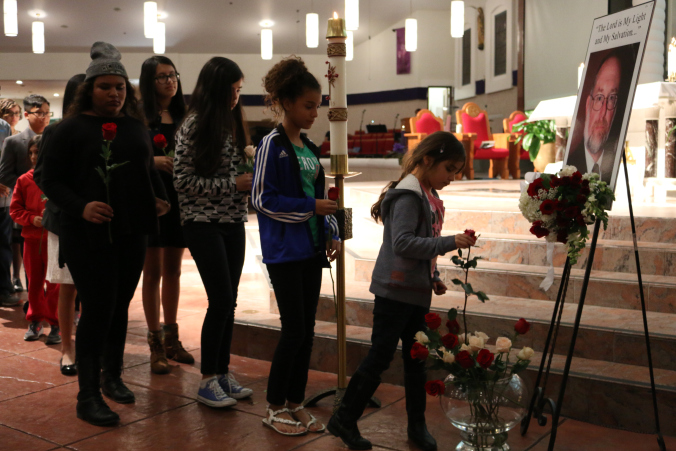
 understand it may be a slow and long process. People are afraid and have many mixed emotions. However, we as a faith community would like to be a source of hope because as Bishop Barnes expressed at the interreligious prayer vigil: “We believe that love is greater than hate; courage greater than fear; unity greater than separation.”