Serving the Local Community: Catholic Colleges and Universities Partner with CCHD

Inspired by their mission, Catholic colleges and universities serve their local communities in many ways, including building partnerships to work for the common good. Since 2010, Association of Catholic Colleges and Universities (ACCU) member institutions have partnered with community organizations funded by the Catholic Campaign for Human Development (CCHD), the domestic anti-poverty program of the U.S. Catholic Bishops. Together they collaborate on initiatives that help people in their local communities who are living in poverty participate in decisions that affect their lives, families and communities. These organizations are dedicated to empowering people to create change in their local community through solidarity and education. Saint Joseph’s University, the University of Dallas, and Marquette University are just a few of the institutions addressing local issues of poverty through these partnerships, providing a concrete way for students to live out the principles of Catholic Social Teaching.

At Saint Joseph’s University, students have the opportunity to work with Urban Tree Connection, a non-profit organization funded by CCHD that works with people living in Philadelphia’s most disadvantaged neighborhoods to develop community-based greening and gardening projects. Urban Tree Connection (UTC) empowers members of the local community by training people in farming and other agricultural skills and making fresh produce more widely available. Their projects are created on vacant land to create safe and functional spaces that promote positive human interactions. Saint Joseph’s University’s Sustainability Committee and Institute for Environmental Stewardship work with UTC to provide access to the Community Supported Agriculture (CSA) program at UTC to faculty, staff, administrators, and students at the university. Subscribers to the CSA receive vegetables from UTC’s urban farms, supporting their efforts to transform abandoned lots into community gardens.

In addition to promoting the CSA program, students at SJU are also encouraged to work with UTC in their community gardens through the Philadelphia Service Immersion Program and the Magis Program. The Philadelphia Service Immersion Program is an optional early move-in experience for first-year students. This four-day program introduces incoming freshmen to the Jesuit values of social justice, service to those on the margin, moral discernment, and intellectual inquiry through community service learning. This past fall, six students volunteered with UTC through the program. Each evening, the students reflected on what they learned and experienced that day in a small group discussion led by incoming sophomores. Another opportunity available to connect students to UTC is the Magis Program, a semester-long service and social justice program for first-year students. Students meet weekly in small groups for community service, social justice education, and reflection. UTC is one of the sites where students can serve for the semester as part of the Magis Program.

Like St. Joseph’s, other Catholic campuses are finding that partnerships with CCHD-funded groups provide mutual benefits for all the partners. For example, the University of Dallas partnered with the local diocesan CCHD staff to educate students about the reality of poverty in the United States. Working with students and staff, together they created the Journey to Justice Retreat (J2J) to teach students about the issue of poverty in the local area and throughout the country. Using resources from CCHD such as Poverty USA, participants learned about the effects of poverty on people all over the country.

The J2J Retreat featured a focus on the CCHD-funded group Texas Tenant Union (TTU). TTU is a community organizing group dedicated to securing more and higher quality low-income housing by advocating for legislation, providing free legal counsel for low-income tenants, and offering rights education and counseling for tenants. Former diocesan CCHD intern Colleen McInerney, an alumna of the University of Dallas, says the retreat showed students the importance of CCHD in that TTU “wouldn’t have been able to do nearly as much without the CCHD resources” available to it, which inspired many students to get involved with anti-poverty organizations. The retreat was well-received and students hope that the university will be able to host the retreat again in the future.

In addition to hosting service opportunities and working together on educational programming, Catholic colleges and universities can partner with CCHD-funded organizations to learn more about advocacy within the nation’s political system. Marquette University offers students a way to become involved in advocacy through courses that incorporate service learning and through an internship. Project Return assists men and women who have experienced incarceration in making a positive reentry to the community. Each academic year, students work at Project Return for ten hours a week , helping clients find jobs and housing, work through personal issues, and celebrate accomplishments. They learn about the process of reentry by visiting a prison, meeting parole officers, and witnessing a reentry court run by a federal judge. In addition to learning more about the issue, students most recently advocated with community leaders, canvassed neighborhoods on issues surrounding criminal justice reform, and organized a community mental health day.

The project also enables Marquette student interns to work with a mentor on a variety of tasks and to incorporate their own academic interests into the internship. One student intern during the past year worked to launch a mental health initiative to accommodate clients in need of psychological services. Ed de St. Aubin, Ph.D., the director of the internship program, commented, “The social justice mission of our Jesuit university is completely aligned with the mission of Project Return.” De St. Aubin noticed how the experience opened students up to more growth than a classroom could have afforded, exposing them to numerous human factors connected to criminal justice reform, such as race relations, ethnic disparities, and faith development. Recently, de St. Aubin, as well as interns Max Hughes-Zahner and Alex Krouth, were guests on RiverWest Radio Milwaukee’s show, Expo: Ex-Prisoners Organizing. Hughes-Zahner, a junior at Marquette, noted on the show that this internship “was very important for me to experience it from that side because previous to that I had really only experienced classroom learning about incarceration and prison.”

Saint Joseph’s University, the University of Dallas, and Marquette University are working with local organizations to create community-based solutions to issues of poverty and inequality. Their partnerships with CCHD-funded groups enable them to live the values of Catholic Social Teaching and have a visible effect on the surrounding neighborhoods. Students are able to work alongside those living the issues they are working to resolve, giving them an experience of solidarity. Through a partnership with an organization funded by CCHD, Catholic universities make a difference in their communities and give students experience in what it means to have a faith that does justice.

Camilla MacKenzie is an undergraduate student at The Catholic University of America and former Peace and Justice Intern at the Association of Catholic Colleges and Universities.

This post was adapted for ToGoForth. Read the original version at the ACCU Peace and Justice blog.
Remembering Global Persecution of Christians during the Fortnight for Freedom

In 2011, Shahbaz Bhatti, a Catholic and Pakistan’s Federal Minister for Minorities Affairs, was gunned down just outside his home in Islamabad. Last year, Church officials in Pakistan opened a cause for his beatification. Bhatti’s life was striking for the depth of his vocation. He had taken up his post out of a calling to protect Pakistan’s downtrodden minorities. Knowing that his life was in danger, he had renounced marriage so as not to leave behind a fatherless family. Shortly before he was assassinated, he stated in a video, “I believe in Jesus Christ who has given his own life for us, and I am ready to die for a cause. I’m living for my community … and I will die to defend their rights.”

As the Church rightly draws our attention to the growing curtailment of religious freedom in the United States in recent years during this Fortnight for Freedom, let us not forget that Christians around the world like Bhatti suffer the violation of their religious freedom through killing, torture, arbitrary arrest, unjust interrogation, the burning of their churches and property, and numerous forms of heavy discrimination.

“How many people are being persecuted because of their faith, forced to abandon their homes, their places of worship, their lands, their loved ones!,” exclaimed Pope Francis in a recent video. A report published earlier this year by the Center for Studies on New Religions in Turin, Italy, held that some 90,ooo Christians were killed for their faith around the world in 2016 and that between 500 and 600 million Christians were in some manner persecuted or barred from living out their faith.

While the mainstream media and major human rights groups by and large have not given the global persecution of Christians the coverage that it deserves, we can be grateful that some important voices have brought the trend to the world’s attention. Critical, for instance, was the U.S. State Department’s decision to designate as genocide the persecution of Yazidis, Christians, and other religious minorities in Syria and Iraq in March 2016.

Once the world comes to acknowledge the persecution of Christians, the question must then be asked: What do Christians do when they are persecuted? How do they respond?

Bhatti responded to persecution not only through being ready to accept martyrdom but also through constructively promoting religious freedom through political means. For instance, he advocated for the reform of Pakistan’s draconian blasphemy laws, constructed coalitions of religious communities, and counseled the forgiveness of his enemies.

How Christians around the world respond to persecution is the subject of the Under Caesar’s Sword project, based at the University of Notre Dame and the Religious Freedom Institute. The project’s premise is that with good answers to these questions in hand, the rest of the world can exercise more effective solidarity with persecuted Christians.

On a generous grant from the Templeton Religion Trust, the project assembled a team of fourteen world class scholars of global Christianity and sent them out to investigate how Christian communities respond to persecution in countries ranging from Iran to Indonesia, Syria to Sri Lanka.

The findings were numerous (and reported here). The most common responses to persecution were strategies of survival, through which communities seek to remain alive and to practice their most basic activities. The second most common response was strategies of accommodation, through which they seek to strengthen their position by constructing relationships with other churches, religious communities, and secular actors – much like Bhatti did. The least common was strategies of confrontation, which involves direct opposition to persecuting regimes, including martyrdom, the fate that Bhatti ultimately met. Striking was the rarity of violence as a response to persecution. Evangelicals and Pentecostals suffered more persecution, and reacted more assertively to persecution, than older, established churches like Catholic and Orthodox communities. The most central finding was that Christian communities engage in a creative pragmatism by which they undertake short-term measures to build their position with the long-term theological hope that one day the persecuting regime will fall and that they will then blossom.

With these findings in hand, we who live in relatively free environments may actively support our beleaguered brothers and sisters who, like Bhatti, struggle to respond faithfully to persecution.

“I ask you: how many of you pray for persecuted Christians?,” queries Pope Francis.

No time is better to undertake such prayer – as well as other forms of support – than the Fortnight For Freedom.

Daniel Philpott is Professor of Political Science at the University of Notre Dame


Religious freedom | It is more than freedom to worship

In a class I co-taught on religious freedom last fall, many of the students seemed to arrive with a sense that there wasn’t much to talk about. In the U.S., we have always given individuals religious freedom, and we should keep doing that. If any question should arise the maxim of John Stuart Mill— “Your right to swing your arms ends just where the other man’s nose begins”—would resolve the matter quickly.

Happily, our location at least suggested the topic’s rich history. Our class took place in Providence, Rhode Island, two miles or so from the spot where Roger Williams, banished from the Massachusetts Bay Colony on account of his views, stumbled out of the wilderness to begin a radical new experiment. In Massachusetts, Williams had spoken publicly against the punishment of religious dissenters. In Providence, he worked with others to establish bold protections for individual “liberty of conscience.” The fruits of that experiment were new forms of religious freedom, and protections for many religious minorities. Indeed, the proximity to our classroom was no accident. Among the religious minorities who sought out this liberty were Catholics, and there is a clear link to Rhode Island’s ultimate (and current) status as the most heavily Catholic state in the union.

As conversation got underway, however, I realized that many of our students held to assumptions that had to be challenged. In our conversations, the complexity and importance of religious freedom began to emerge.

First, many of our students understood freedom of religion as reducible to freedom of worship. Freedom to worship is certainly a crucial freedom, but freedom of religion is a much broader category, and one that goes beyond the private sphere into the public square. Freedom of religion involves the ability to organize schools and other charitable organizations, to enter into the political process with religious commitments, and generally to conduct oneself in accordance with one’s religious convictions and conscience. It is here, of course, in interaction with those whose religious convictions differ, that challenges can arise.

Second, many of our students assumed that the only interpretation of the First Amendment consisted in a Jeffersonian sense of a “wall of separation” between church and state. Thomas Jefferson used this phrase in a letter he penned in 1802, and it offers a metaphor that seems to be extremely stark: these two entities are to be separated in an absolute, with neither touching the other in any way. In the last fifty years or so, this has become an increasingly prevalent interpretation of the First Amendment. But it was not always so. Jefferson himself was more complicated in practice. As governor of Virginia, he called for public days of prayer, and as president, he directed federal funds to Christian missionaries and encouraged local governments to make land available for Christian purposes. John Adams, meanwhile, leaned more in the direction of what has come to be called the “accommodationist” view: the belief that religion is essential is fostering moral values required for maintaining civil order, and that religion is part of the national heritage. The precise meaning of the First Amendment is not simple, but it is crucial for the way in which we understand freedom of religion.

Finally, many of our students were simply unfamiliar with the tradition at the very heart of Christianity that requires fidelity to God before fidelity to any other authority, including civil government. They might have heard of early Christian martyrs, but they did not know that martyrs could have escaped their fate, if they would only have offered worship to Caesar. Even more immediately relevant, they did not know of the Thomistic tradition—essential to modern civil disobedience—that insists that laws not rooted in the larger ideal of justice are not to be regarded as laws at all. In some cases, disobedience to laws of this kind is actually a moral imperative.

Over the course of the semester, we discussed many topics, but these three especially made us all more aware of what is at stake in advancing claims of religious freedom—and why such claims must be treated with great care.

Holly Taylor Coolman is Assistant Professor of Theology at Providence College.

Forging a Path to Interreligious Action for Peace

What does it take to build peace among people divided by religion? Is it dialogue about beliefs, traditions, and values that creates greater understanding, and thus more harmony? Or is it joint action that generates cooperation and strengthens relationships? The resounding answer from Catholic Relief Services’ interreligious peacebuilding experience is: both. Talking theology matters, but so does the opportunity to work side-by-side and put values into practice.

In Bosnia-Herzegovina, where Catholic Relief Services (CRS) has been supporting peace and development efforts since the height of the country’s civil war, programs invite people to connect through dialogue and action. Young people, many of whom attend segregated schools and have never heard stories of the war from the perspective of other ethnic and religious groups, jointly visit one another’s places of worship, perform musical concerts together, and collaborate on art exhibitions, and carry out cooperative community initiatives across religious lines. These shared activities are important to create common experiences and connections.

But deeply held perceptions and attitudes do not change through these joint activities alone; it is also important to delve into values and histories that connect and divide people. Young people have the opportunity to do so through seminars, dialogue sessions, and participatory theatre. Another important tool that CRS has been using in Bosnia-Herzegovina has been “Speaking Out” events, in which war victims share their stories of suffering at the hands of other ethnic and religious groups, and their journeys towards reconciliation. For many in the audience, young and older, this may be the first time that they are confronted with the “other side’s” narrative of the past. While this is challenging, it also opens them to the possibility of greater empathy for people from the other groups.

The stronger relationships and improved mutual understanding that emerge from activities like these prepare the ground for concrete steps towards reconciliation. These can include local initiatives involving ordinary citizens as well as building a vision for changes in the institutions that touch the lives of the broader population. A case in point is a national “Platform for Peace” just recently adopted by the highest level of government in Bosnia-Herzegovina. This Platform, developed at CRS’ initiative in collaboration with local partners and a range of key leaders, commits government officials and other authorities to work for long-term peace and reconciliation through measures such as institutionalizing trust-building mechanisms, reducing divisive rhetoric, and promoting peace education in schools. Over 40% of the country’s mayors have also signed on to the Platform for Peace, and have pledged to dedicate resources from their local budgets to put it into action.

In another landmark move, the deans of the country’s three theology schools – Catholic, Orthodox, and Muslim – recently announced a joint Master’s degree program in interreligious peacebuilding. This program, which will accept its first students in the fall, is the first of its kind in the region. It is the fruit of several years of patient and steady work on the part of the seminary representatives, supported and accompanied by CRS as they worked to bring their vision to life. Graduates of the program will emerge with a strong grounding in the three faith traditions’ teaching on peace, justice, and ethics; internship experiences will also give them strong practical skills to contribute to forging unity in their communities and country.

What barriers divide people of different faiths in your community? What opportunities do you see to forge connections across these barriers, through dialogue and action?

Nell Bolton is Senior Technical Advisor for Justice & Peacebuilding at Catholic Relief Services.

To learn more about what works in interreligious peacebuilding, download a copy of CRS’ new book, Interreligious Action for Peace: Studies in Muslim-Christian Cooperation.

Pray for Religious Freedom

Aaron Weldon, Religious Liberty Program Specialist, USCCB

We come to enjoy true freedom when our restless hearts find rest in the truth. The great twentieth century philosopher, St. Teresa Benedicta of the Cross – or, Edith Stein – discovered truth in the writings of St. Teresa of Avila, and sought freedom by entering the Discalced Carmelites. The convent didn’t stop her from reaching out. During the rise of Nazism, Stein spoke up. She wrote to Pope Pius XI asking the Church to speak up on behalf of persecuted Jews, and she wrote her autobiography, Life in a Jewish Family, “as a way to combat racial hatred.” She was captured in 1942 and taken to Auschwitz, where she died in the gas chamber shortly after arrival. Stein was executed primarily because she was Jewish, and the Catholic Church considers her a Christian martyr, because she bore witness to her faith in Jesus before her executioners.

Having spent much of my life in the university, I admire Edith Stein. Her intellectual vocation led her to faith, her relationship with God led her to prayer, and her life of prayer was bound up with her outreach to others. She enjoyed an interior freedom that opened out to service.

We can grow in both interior freedom and solidarity with others through prayer. In prayer, we express our dependence on God, and we take on the burdens of those for whom we pray. During this Fortnight, here is how I will be praying:

  • For Bishops and all Catholic leaders. Many Christians may not realize religious liberty is an issue, because they don’t experience an infringement on their own freedom. But the issue is real for medical professionals like Cathy Decarlo, a nurse who was forced to participate in an abortion, or for ministries that serve immigrants in states prohibiting the “harboring” of undocumented persons. Pastors and leaders face serious challenges, and they need the wisdom and courage of the Holy Spirit. We can pray for them.
  • For Christians facing violent persecution. In the West, we are dealing with what Pope Francis calls “polite persecution.” Polite persecution is real, but it pales in comparison to the struggles of Christians in Pakistan, Syria, and other places. In the face of this suffering, it can be difficult for most of us to know what we can do. Certainly, we can support organizations, like Aid to the Church in Need, that work to assist Christians under extreme duress in places like Iraq. We can also pray for our brothers and sisters, as well as for the conversion of the persecutors.
  • For non-Christian fellow Americans. Religious freedom is a fundamental freedom, rooted in the nature of the human person. So all people must be immune from coercion, free to pursue the truth and live the truth as best as they understand it. Many Americans are impeded in their search. For example, Muslims have faced challenges in recent years. Several states have passed anti-Sharia laws, local governments have tried to use zoning laws to prevent the construction of houses of worship, and the White House has imposed a travel ban that courts have found is aimed at preventing Muslims from entering the country. These actions give rise to a culture in which Muslims are treated as second-class citizens. As Catholics, we should be aware of these challenges, as we ourselves have been the target anti-Catholic bigotry. That bigotry gave us Blaine Amendments that we are still fighting today. Religious freedom for all does not mean we are resigned to relativism; it simply means that governments do not get to coerce people in matters of faith. It means that the state recognizes a space for non-state institutions, and this is the same space we Christians enjoy to propose the truth of the Gospel of Jesus Christ.

Please join me in praying for our neighbors, co-workers, and fellow Americans, that we all will be free to seek and live out religious truth.

Aaron Matthew Weldon is Religious Liberty Program Specialist for the United States Conference of Catholic Bishops.

Our Border Family: Hope at the Border

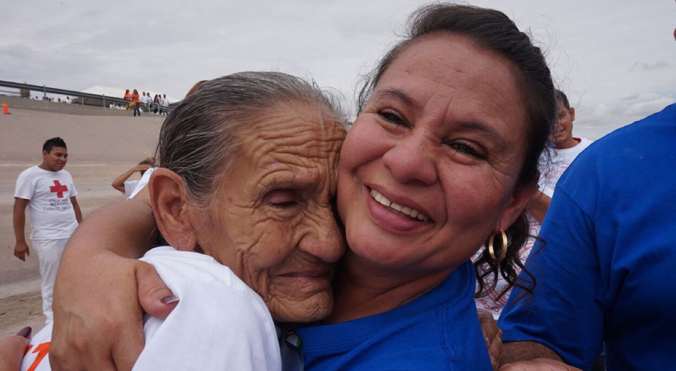
During “Hugs Not Walls,” families who live separated by the United States-Mexico border were able to see and embrace each other for a few previous minutes.

The Catholic church is taking a compassionate, non-confrontational approach to the plight of people in three dioceses along the U.S. border with Mexico. It’s also using exquisitely simple, Gospel-based principles to underscore human dignity and address systemic poverty and injustice.

Bishop Mark Seitz of El Paso told me his Texas diocese and the contiguous ones in Juarez, Mexico and Las Cruces, New Mexico form the largest bi-national community in the hemisphere, if not the world. “The very nature of our border area is it’s a family. It’s a large community that has had a line drawn through it,” he said. And it has long been this way. People in the area move freely across the border to shop, eat, and be with family. The result is an active community where the unique nature of the towns on either side of the river contributes something to strengthen and improve their neighbors.

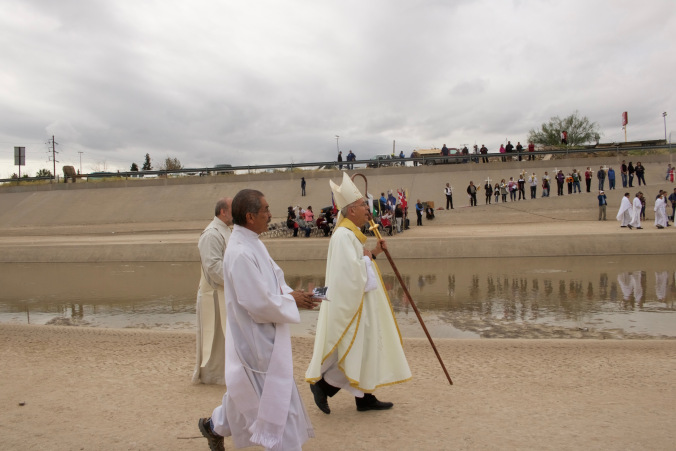
Bishop Seitz of El Paso celebrates Mass on the United States-Mexico border.

The longstanding reality of intermingled families and thriving communities is a counterpoint to an increasingly strident national narrative about borders. Bishop Seitz points to the head-scratching portrayal of the border as a forbidding place of confrontation “where the ‘us’ people fend off the ‘them’ people, where the people at home fight off the aliens. That has no resonance here,” he said.

The Hope Border Institute is a new-since-2015 grassroots effort to apply Catholic social teaching principles to immediate and longer-term issues along the border. It sprang from conversations among local clergy in the three dioceses and people in several groups funded by the Catholic Campaign for Human Development (CCHD). They were looking for a way to address the fall-out from a growing number of policies imposed on the area that frankly made little sense.

When I asked him about it, Dylan Corbett, the group’s executive director, said laws and regulations made in Austin, Washington, DC and Mexico City do not necessarily correspond to realities on the ground. Sometimes they cause new problems without solving the challenges they were intended to fix. He pointed out there is already a wall and a new wall likely won’t do what is promised because it doesn’t address the root causes of poverty and injustice on both sides of the border and won’t stop the flow of illegal drugs.

The Hope Border Institute brings together CCHD-funded groups, activists, and grassroots organizations, low-wage workers and migrants, members of the media, young persons, academics, church workers, and clergy to share perspectives, explore Catholic social teaching, and look through the eyes of others living in the border communities. It helps people work collectively and intentionally across “borders” of geography, race, and ethnicity. And it trains and empowers leaders across both the faith community and civil society to witness the power of unity in diversity and community.

Best of all, it’s working! People who might never have spoken and shared stories now see and begin to understand the experience, perspective, and human dignity of each other.

Bishop Seitz said, “The role of the Church and its teaching is such an important counterpoint to the uninformed reaction people have had to these border questions.” How true.

Beth Griffin is a free-lance journalist with an abiding interest in social justice.

Hope Border Institute is funded by the Strategic National Grant Program of the Catholic Campaign for Human Development. Read more about their work in the most recent edition of the CCHD Newsletter: Helping People Help Themselves.


Going Deeper!

The Catholic Campaign for Human Development and the Office of Education & Outreach are partnering to foster encounter in other ways. Our new small grants program seeks to foster Hispanic ministry-social justice diocesan collaboration, and this recent webinar lifted up examples of where this is already successfully happening around immigration, workers’ rights, trafficking, and other issues affecting the immigrant community.


All photos courtesy of Hope Border Institute.

Get Ready for World Refugee Day!

Todd Scribner, Education Outreach Coordinator, Migration & Refugee Services/USCCB

Every year on June 20, the international community acknowledges World Refugee Day. World Refugee Day provides an opportunity to reflect on the conditions confronting the millions of people who have been forced from their homes and countries under threat of persecution and possible death and to acknowledge their humanity.

The United Nations High Commissioner for Refugees estimates the number of forcibly displaced people globally to be at about 65.3 million, including 21.3 refugees. We are today experiencing the largest refugee crisis since the end of World War II. This is a troubling fact that deserves careful attention and global collaboration.

World Refugee Day provides us all an opportunity to better understand the international circumstances that give rise to displacement, the various solutions that are in place to respond to the problem, and the important role of the U.S. resettlement system in this process. While important, it is not enough for us to merely learn about refugees; we must also act and advocate in solidarity with them

At a recent audience of Catholic and Lutheran pilgrims, Pope Francis emphasized this point, declaring that “you cannot be a Christian without living like a Christian… It is hypocrisy to call yourself a Christian and chase away a refugee or someone seeking help, someone who is hungry or thirsty, toss out someone who needs my help.”

Spurred by the Holy Father’s words, we turn to numerous refugee crises around the world about which we can both learn and act upon.

The crisis in Syria and Iraq continues to be a pressing concern for the leadership of the Catholic Church as countless millions of men, women, and children continue to be displaced and persecuted because of the ongoing conflict. The forced migration of children and families from the Northern Triangle in Central America is also a troubling phenomenon.

In both situations, the Catholic bishops of the United States have called for expanded protections for the most vulnerable populations in these migrant flows. It is imperative that the international community of nations and civil society, including faith communities, work together in both challenging situations, addressing the root causes of forced migration and putting into place solutions that will provide alternatives to forced migration in both regions.

While both Syria and Central America continue to be a source of troubling refugee crises, we should not forget other parts of the world wherein forced migration is also ongoing phenomenon. The conflict in South Sudan has stretched on for over four years, and is Africa’s largest displacement crisis today. As of October 2016, 1.2 million people had fled South Sudan as refugees to neighboring countries. Other sizable populations have fled the Democratic Republic of the Congo, Eritrea, Somalia, and elsewhere in recent years.

We invite you to download, distribute, and use our World Refugee Toolkit, which contains spiritual-related resources, as well as advice on how to use media to draw attention to the problem, and suggested initiatives that you can use in your local community.

Additionally, a series of other resources is available that highlight various aspects of the refugee resettlement program is available. These publications were created to help you better understand issues related to refugees and other forms of forced migration.

Finally, in addition to learning about these issues, it is important that we act. One way that you can do this is by signing up for the Justice for Immigrants campaign. By doing so, you will receive information about new resources as they become available alongside time sensitive action alerts. By engaging these alerts, you will be in a position to help shape public policy on migration related issues and to help ensure that the human dignity of migrants is respected in the law and in our communities.

Todd Scribner is the Education Outreach Coordinator for Migration & Refugee Services at the USCCB.